
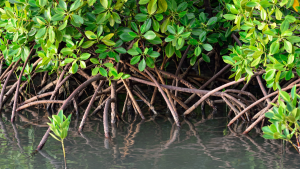
When people think of Belitong, they often picture stunning beaches, granite rocks, and turquoise seas. But hidden along its coasts is another treasure, for example mangrove forests, one of the most important ecosystems for both nature and people.
Mangroves act as natural shields. Their roots protect the shoreline from storms and erosion, while also filtering water and supporting fish, crabs, and other marine life. But beyond that, mangroves are climate heroes. Though they cover less than 1% of coastal areas worldwide, they store up to 15% of global carbon, earning them the title of blue carbon ecosystems. Most of this carbon is locked deep in their soils, making mangroves one of the most efficient natural solutions for fighting climate change.
Belitung’s Carbon Bank
Recent studies show that Belitung’s mangroves are especially rich in carbon. With more than 10 species, including Rhizophora apiculata and Bruguiera gymnorrhiza, these forests store over 112 tons of carbon per hectare—equivalent to absorbing over 400 tons of CO₂. This makes them more effective than many inland forests at capturing carbon pollution.
Challenges Ahead
Despite their value, mangroves are disappearing globally at a rate of 1–2% per year due to deforestation, land conversion, and rising seas. In Belitung, mangrove areas are under pressure from development and unsustainable land use. Losing them would mean not only releasing stored carbon into the atmosphere but also weakening coastal protection and reducing fisheries that support local livelihoods.
Conservation and Community Power
Protecting mangroves means keeping people’s prosperity. Healthy mangroves support eco-tourism, sustainable fisheries, and even creative industries like mangrove honey or eco-crafts. Local communities play a crucial role in replanting, monitoring, and safeguarding these ecosystems. Their traditional knowledge, combined with modern conservation strategies, can ensure mangroves thrive for generations.
A Shared Responsibility
The Indonesian government has set an ambitious target to restore 600,000 hectares of mangroves by 2024. Belitung, as part of the Belitong UNESCO Global Geopark, has the chance to lead by example showing how conservation, science, and community participation can work together. By treating mangroves as both natural carbon banks and sources of local prosperity, Belitung can become a model of sustainable coastal management.
The future of Belitong’s mangroves depends on all of us. Safeguarding them means cleaner air, stronger coasts, richer biodiversity, and better livelihoods for the people who call this island home.