
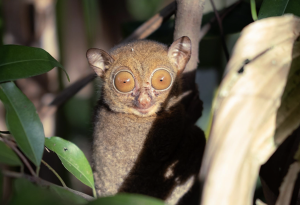
Hidden deep within the lush forests of Belitung lives a creature so small and enchanting it seems lifted from a fantasy tale, the Belitong Tarsier (Cephalopachus bancanus saltator). With its marble-like eyes and ability to leap several meters in a single bound, this tiny primate is one of the island’s most extraordinary treasures.
Though it belongs to the primate family, the tarsier is no larger than a human fist, weighing only 80 to 160 grams. Its most striking feature is its oversized eyes—the largest relative to body size of any mammal—perfectly designed for its nocturnal life. When night falls, the tarsier becomes a silent predator, hunting insects, small reptiles, bats, and even birds. Unlike most primates, it is a strict carnivore.
Belitong’s tarsier is a rare subspecies of the Western tarsier, found only in Sumatra, Borneo, and Belitung. It is slightly larger than its relatives in Sulawesi and the Philippines, and while those species shelter in tree hollows, the Belitong tarsier prefers leafy canopies. Uniquely, it relies on its sensitive ears to process ultrasonic waves rather than vocal calls to communicate.
Its appearance is unforgettable: large, soulful eyes framed by dark circles, giving it a melancholic, almost ghost-like charm. During the day, it rests quietly, often spotted observing visitors with its haunting gaze. But when night comes, those same eyes become powerful tools, enabling sharp vision for hunting. Coupled with its remarkable ability to rotate its head 180 degrees, the Belitong tarsier is an efficient, agile predator.
Yet, this rare primate faces serious threats. Deforestation, habitat fragmentation, and illegal wildlife trade have placed it in jeopardy. Because it depends on dense forest cover, even minor disruptions can put its survival at risk. Beyond its charm, the tarsier plays a vital role in keeping Belitung’s ecosystem balanced by controlling insect populations.
Protecting the Belitong tarsier ultimately means protecting Belitung’s forests. Conservation efforts such as raising awareness, promoting eco-tourism, and preserving natural habitats are crucial. One inspiring example is at Bukit Peramun Geosite, where visitors can join guided night tours to watch the tarsier in its natural habitat. This eco-tourism experience not only offers a magical encounter with the island’s “wide-eyed guardian,” but also directly supports local communities in their conservation mission.
To experience this for yourself and help preserve Belitung’s biodiversity, visit peramun.com to book your tarsier-watching adventure.