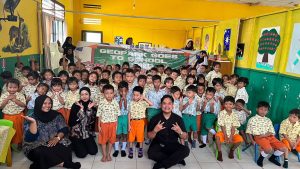
On January 21, 2026, the Belitong Geopark education team visited Kartika Kindergarten. | The Belitong UNESCO Global Geopark education team, embracing our little family from Kartika Kindergarten in a shared journey of love and learning.
“Before a child understands the world, they learn to feel it, and in that feeling, they begin to protect it.” – Muhammad Belva Juliadi.
In the earliest stages of human development, knowledge is not yet structured as abstraction, but felt as experience. Within the warm and receptive environment of Kartika Kindergarten in Tanjungpandan, learning unfolds as curiosity, and curiosity becomes the first gateway to meaning. The visit conducted by the Belitong UNESCO Global Geopark Management Body can be understood not merely as an outreach program, but as an epistemological intervention, one that situates environmental awareness within the formative architecture of early cognition and emotion.
At the core of this initiative lies a fundamental proposition in environmental philosophy and developmental science: that ecological ethics emerge from affective bonds rather than prescriptive norms. The child does not begin with rational obligation toward nature, but with attachment, wonder, and sensory familiarity. This aligns with constructivist theories of learning, where knowledge is actively built through interaction with the environment, as well as with biophilia hypotheses suggesting an innate human inclination to connect with living systems.
The pedagogical design of the program reflects an integration of play-based learning and science communication frameworks. Through games, storytelling, and interactive materials, environmental knowledge was translated into embodied experiences rather than abstract instruction. This approach resonates with contemporary research in cognitive psychology, which emphasizes that multimodal engagement enhances neural integration, emotional resonance, and long-term memory formation. In this sense, the activity functioned as both education and cognitive scaffolding.
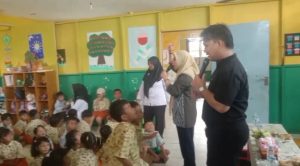
Muhammad Belva Juliadi and Winarty are engaging in a question-and-answer session about the environment.
What distinguishes this initiative at a deeper level is its deliberate interdisciplinary composition. The presence of Muhammad Belva Juliadi as a psychologist, Cecen Nurlita as a researcher in green governance, Winarty as a marine biologist, and Raisya Desvita as a tourism student from Politeknik Belitung represents more than a collaboration of professions; it embodies an epistemic convergence. Each discipline contributes not only content, but a distinct way of knowing. Psychology frames the mechanisms of attention and emotional bonding, governance situates individual behavior within systems of responsibility, marine biology anchors learning in empirical ecological realities, and tourism studies connect conservation to socio-economic sustainability.
From the perspective of interdisciplinary theory, this convergence reflects a transition from multidisciplinarity to transdisciplinarity. Rather than juxtaposing separate domains, the program synthesizes them into a unified narrative that dissolves boundaries between knowledge systems. Such an approach is critical in sustainability science, where environmental issues are understood as complex, adaptive systems requiring integrated frameworks that span natural sciences, social sciences, and humanistic inquiry.
The act of simplifying scientific knowledge for children, often perceived as reduction, is here better understood as translation across epistemic levels. The facilitators did not dilute meaning, but recontextualized it into forms compatible with early cognitive structures. This reflects principles in science communication theory, where effectiveness is measured not by informational density, but by relational accessibility. In this context, knowledge becomes meaningful not when it is fully understood, but when it is emotionally and intuitively internalized.
A particularly profound layer of meaning emerges through the personal trajectory of Muhammad Belva Juliadi, who returned to Kartika Kindergarten as both educator and former student. This moment represents a lived example of developmental continuity, illustrating how early educational environments contribute to the formation of identity, values, and intellectual pathways. It also reflects the sociological concept of reflexivity, where individuals re-engage with their origins as agents of transformation.
Philosophically, this return can be interpreted through the lens of temporal circularity, where past, present, and future are interconnected within lived experience. The classroom becomes not merely a physical space, but a site of memory, transformation, and renewal. The children, witnessing this narrative, are subtly introduced to the possibility that their present selves are already in dialogue with their future identities.
Beyond the immediate educational setting, the initiative reflects a broader governance philosophy that emphasizes cultural and educational processes as the foundation of sustainability. It underscores that sustainable development is not solely a function of regulatory frameworks or technological solutions, but is deeply rooted in value formation. By embedding environmental awareness at the level of early childhood, the program advances a long-term strategy that aligns behavioral change with identity development.
From a systems perspective, this activity can be seen as a micro-level intervention within a larger socio-ecological system. Small-scale interactions, such as a child learning to appreciate their environment, may appear insignificant in isolation, yet they contribute to emergent patterns of collective behavior over time. This reflects principles in complexity theory, where macro-level outcomes arise from the accumulation of micro-level processes.
Ultimately, the encounter between little dreams and gentle guidance is not merely poetic, but conceptual. The children of Kartika Kindergarten are not passive recipients of knowledge, but active participants in the early construction of ecological consciousness. Through interdisciplinary engagement, emotional connection, and experiential learning, they begin to form relationships with their environment that may one day evolve into stewardship, innovation, and leadership. In this convergence of science, philosophy, and education, the foundations of a resilient and sustainable Belitong are being thoughtfully and deliberately shaped.
Corresponding Author: Arry Aditsya Yoga | Researcher in International Law, Ecopolitology, and Anthropology