
As part of the Belitong UNESCO Global Geopark, Belitung Island is widely recognized for its distinctive granite formations and stunning coastal landscapes. However, beyond its visual appeal, the island also demonstrates a remarkably strong environmental performance particularly in terms of air quality.

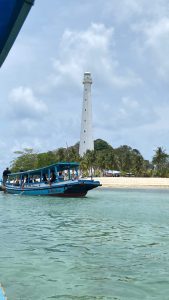
One of the most immediate and tangible indicators of this environmental quality is the clarity of its blue sky. Unlike in many urban areas where the sky often appears hazy or grey due to high concentrations of air pollutants, the atmosphere in Belitung remains visibly clear. This is not merely an aesthetic feature, but a reflection of low levels of particulate matter in the air, allowing natural light scattering processes to dominate and produce a brighter, more vivid blue sky.
Image source: personal photograph by Kharisma Rinandyta
In a broader national context where many cities in Indonesia continue to face increasing air pollution challenges, Belitung stands out as an exception. The island consistently maintains clean, stable, and health-safe air conditions, positioning it as an important benchmark for environmental quality management in archipelagic regions.
National Standing: Latest Air Quality Insights (2025)
According to the latest report released by the Nafas Foundation (September 2025), Belitung ranks first as the region with the best air quality in Indonesia, recording an average PM2.5 concentration of approximately 11 µg/m³.
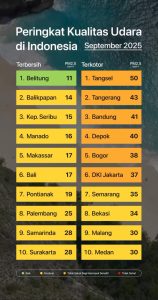
Image source: Nafas Foundation (September 2025)
This achievement places Belitung significantly ahead of major urban centers such as Jakarta, Bandung, and South Tangerang areas that continue to experience higher levels of air pollution due to dense populations, transportation emissions, and industrial activities.
What makes this finding particularly important is its consistency. The data does not represent a temporary improvement, but rather reflects a sustained pattern of clean air conditions. As such, Belitung is not only perceived as a pristine destination, but is also scientifically recognized as an area with well-maintained atmospheric quality.
Current Conditions: Real-Time Perspective from IQAir
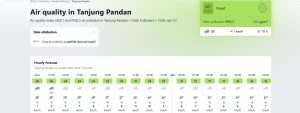
Real-time monitoring from IQAir further reinforces this narrative. In Tanjung Pandan, the current air quality is classified as “Good”, with an Air Quality Index (AQI) of around 36 and PM2.5 concentrations of approximately 6.5 µg/m³.
Image source: IQAir (April 2026)
These values are considered low by both national and international standards, indicating that the air is safe for all population groups, including children, the elderly, and individuals with respiratory sensitivities.
More importantly, the alignment between historical datasets (Nafas Foundation) and real-time observations (IQAir) highlights a key characteristic of Belitung’s atmosphere: its stability. Clean air in this context is not incidental it is part of a consistent environmental pattern shaped by both natural processes and human activity.
Why Is the Air So Clean? A Meteorological Perspective
The quality of air in Belitung is not a coincidence. It is the result of a dynamic interaction between meteorological processes and geographical characteristics that naturally support atmospheric cleansing and circulation.
As a small island surrounded by open seas, Belitung experiences strong and continuous sea–land breeze circulation. This daily exchange of air masses enhances atmospheric ventilation, allowing pollutants to disperse quickly rather than accumulate near the surface. In contrast to densely built urban environments, where air can become trapped, Belitung benefits from an open system where air is constantly refreshed.
In addition, the island’s humid tropical climate plays a crucial role. Frequent rainfall contributes to what is known as wet deposition, a process in which airborne particles are effectively removed from the atmosphere by precipitation. This natural “washing” mechanism reduces the concentration of fine particulate matter such as PM2.5, further improving air quality.
Equally important is the island’s topographical openness. Without enclosed basins or mountainous barriers that can trap pollutants, Belitung allows for free and continuous air movement. This prevents the long-term accumulation of pollutants and supports a more balanced atmospheric system.
From a human activity perspective, the relatively low emission pressure also contributes significantly. Limited heavy industry, lower vehicle density, and minimal large-scale combustion activities mean that the sources of pollution are inherently controlled. This creates a situation where natural atmospheric processes are not overwhelmed by anthropogenic emissions.
Together, these factors form a system in which the atmosphere remains structurally clean, rather than temporarily improved.
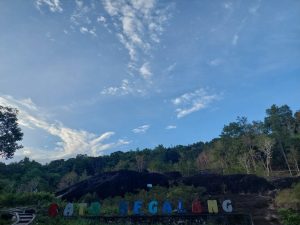
Image source: personal photograph by Kharisma Rinandyta
Within the framework of the Belitong UNESCO Global Geopark, clean air represents more than just an environmental advantage it is a strategic asset that enhances the overall value of the region.
It supports the development of sustainable and health-oriented ecotourism, where visitors not only enjoy scenic landscapes but also experience a genuinely clean and refreshing environment. At the same time, it contributes to the protection of coastal and marine ecosystems, which are highly sensitive to atmospheric conditions.
For local communities, this translates into improved quality of life, reduced health risks, and greater resilience in the face of environmental change. On a broader scale, Belitung offers a compelling example of how environmental quality can be maintained while still supporting economic and tourism development.
Belitung demonstrates that clean air is not simply a matter of geographical luck, but the result of a balanced relationship between natural systems and human activities. The island’s blue skies, fresh air, and stable atmospheric conditions are tangible outcomes of this balance supported by both scientific data and real-world experience.
Corresponding Author: Kharisma Rinandyta | Researcher in Meteorology, Climate Change, and Environmental Science.